Proposal coming soon: EU-Inc before the March Council, Commission date set for 18 March, and the 5 pillars
Proposal coming soon:
EU-Inc before the March Council, Commission date set for 18 March, and the 5 pillars
TL;DR
Next happens (dates):
- 18 March 2026: Commission proposal is scheduled (Legislative Train tracker).
- 19–20 March 2026: European Council meeting (the “March Council”).
- The Commission President said the EU-Inc / 28th regime proposal should come before the March European Council — so we’re watching for publication any day leading into 18 March.
What you get here (weekly + alerts):
- A dated timeline of every milestone (/progress)
- One comparison table that cuts through the PDFs (/compare)
- A primary-source library (/resources)
- A “draft-text alert” the moment the proposal is published
When it’s “ready to use” in the EU (realistically):
- First usable milestone: when the draft legal text is published (that’s when founders, lawyers, VCs can finally review the actual mechanism, scope, and safeguards).
- Actual availability: depends on negotiations + implementation; von der Leyen frames the “One Europe, One Market” ambition as something to reach by the end of 2027.
What changed (and why it matters)
Two things now make this more than “just another EU initiative”: we have a hard tracked Commission date and a political packaging that ties EU-Inc to a broader competitiveness plan. The European Parliament’s Legislative Train tracker states that the Commission’s legislative proposal is currently scheduled for 18 March 2026. And the European Council’s calendar confirms the March summit on 19–20 March 2026.
That matters because it turns the vague “Q1 2026” expectation into a near-term countdown. It also means your next two weeks are about one thing: catching the instant the draft text drops, then translating it into practical implications (incorporation mechanics, cross-border recognition, equity/ESOP treatment direction, and the worker-participation safeguard language).
Ursula’s plan: the five pillars (where EU-Inc fits)
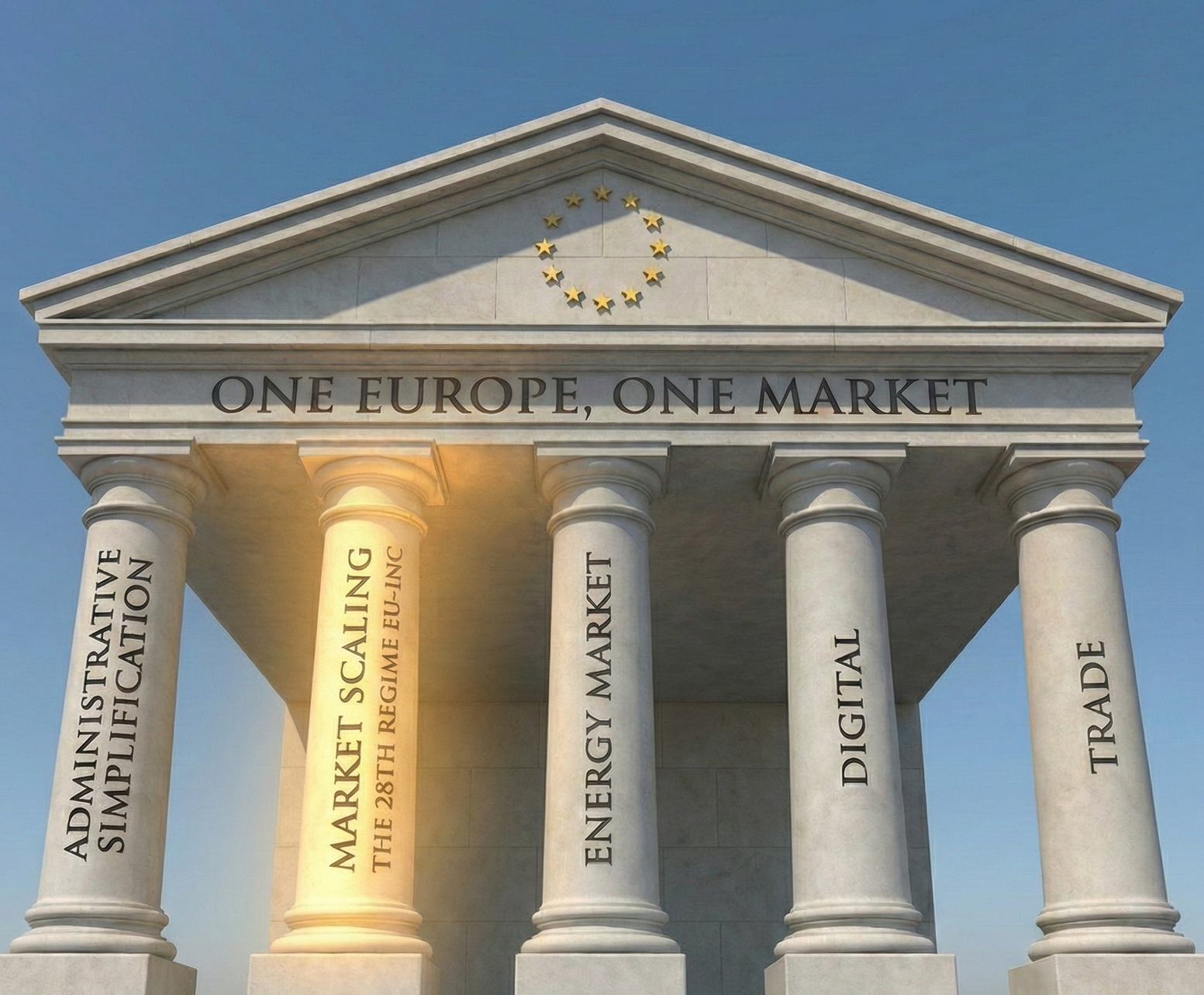
President von der Leyen describes a “One Europe, One Market” roadmap with five building blocks:
- Reduce administrative burden (simplification and fewer fragmented national overlays)
- Build one market (this is where the 28th regime / EU-Inc sits, plus capital markets deepening)
- Build one energy market
- Digital (business wallet / digital identity and “digital-by-default” infrastructure)
- Trade
The key insight: EU-Inc is being positioned as single-market infrastructure, not a “startup perk”. That’s why it’s bundled with “simplification” and “digital” — the EU is trying to remove friction that makes cross-border scaling feel like operating in 27 parallel systems.
If Member States stall: the fallback route
A big signal in the recent coverage is the willingness to use enhanced cooperation (a coalition of at least nine countries) if all 27 can’t move at the same pace — particularly on the broader package that includes capital markets integration.
For founders and advisors, this matters because it changes the risk model: instead of “blocked vs not blocked”, the more likely scenario becomes “first movers vs late adopters”, with expansion over time.
Parliament “fine print” check: does it match the promises?
Parliament has already put a stake in the ground with its recommendations and public communications around a harmonised regime, speed of setup, and EU-wide recognition.
Your readers (consulting, business ops, founders, deep-tech/space) should watch for three “make-or-break” drafting zones in the Commission text:
- How real the ‘single rulebook’ is: what’s truly EU-level vs what still defers to national layers
- Equity/ESOP direction: whether the draft meaningfully reduces the “options chaos” problem or punts it to later workstreams
- Worker participation & labour safeguards: the exact anti-circumvention language will determine political feasibility in Germany and beyond
What we will do the moment the draft is published
Within hours of publication, this tracker will post:
- A plain-English summary of what the draft actually creates (not what people hope it creates)
- A redline-style comparison against Parliament’s priorities and the EU-INC blueprint
- A short “who wins/loses” view for founders, legal teams, investors, and high-growth sectors
If you only follow one page: watch /progress for the dated log, and keep /compare bookmarked for the “one table” view.
Sources:
- European Parliament Legislative Train — “28th regime for innovative companies” (shows Commission proposal scheduled for 18 March 2026)
- European Commission Presscorner — Statement by President von der Leyen (incl. “EU-Inc before the March European Council” + five pillars + end-2027 ambition)
- European Council meeting page — European Council, 19–20 March 2026
- European Parliament press room (vote week / recommendations context)
- Reuters (context on March package + enhanced cooperation fallback)
As the events are to happen next weeks, momentum is rising and the website is growing, spread the information and also this webpage to other founders, consultants and law-makers.
Thanks for the support!